Uncategorized
Magic Truffles vs. Magic Mushrooms: What’s the Difference?
Nov
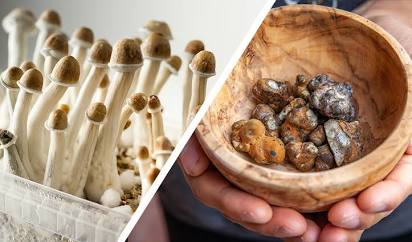
While both magic truffles and magic mushrooms contain the exact same active psychoactive compounds—primarily psilocybin and psilocin—they look, grow, and taste completely different.
Understanding these core differences comes down to simple biology: one grows above ground to reproduce, while the other forms underground to store nutrients.
Here is a clear, beginner-friendly breakdown of how subterranean sclerotia (truffles) compare to traditional fruiting bodies (mushrooms) in growth, harvest, texture, and potency consistency.
1. The Biological Difference: Sclerotia vs. Fruiting Body
The main distinction between the two lies in which part of the fungal organism you are looking at.
Magic Mushrooms (Above-Ground Fruiting Bodies)
A magic mushroom is the fruiting body of the fungus, growing above the substrate or soil level. Its natural function is reproduction. Once fully developed, it opens its cap and releases spores into the air to spread genetics to new environments.
Magic Truffles (Subterranean Sclerotia)
A magic truffle is technically not a gourmet truffle, but a sclerotium (plural: sclerotia). Sclerotia are dense, hardened masses of mycelium that form underground.
In nature, when environmental conditions become unfavorable—such as extreme drought, cold, or nutrient depletion—certain species (like Psilocybe tampanensis, Psilocybe mexicana, and Psilocybe galindoi) form hard nutrient reserves underground to survive until conditions improve.
2. Growth & Harvesting Process
| Aspect | Magic Mushrooms | Magic Truffles |
| Growth Location | Above ground / substrate surface | Underground / embedded within substrate |
| Environmental Sensitivity | Requires controlled humidity, light, and fresh air | Grown entirely in sealed, dark environments |
| Harvesting Technique | Hand-plucked when veils tear (multiple flushes) | Harvested all at once by sifting substrate substrate |
| Prep & Maintenance | Needs daily misting and air exchange | “Set and forget” subterranean growth |
- Mushrooms: Require precise temperature control, high relative humidity (90%+), and regular fresh air exchange (FAE) once fruiting begins. They mature rapidly and drop spores if harvested late.
- Truffles: Grow entirely inside the dark, enclosed substrate jar or bag over several months. Because they remain underground, they require far less daily maintenance and environmental monitoring.
3. Texture, Taste & Moisture Content
Because mushrooms grow into open air and truffles remain packed underground, their physical characteristics differ significantly:
- Magic Mushrooms: Soft, fibrous, and spongy when fresh, containing around 90% water. When dried, they become brittle and cracker-dry, with a mild, earthy, slightly fungal flavor.
- Magic Truffles: Extremely dense, compact, and hard with lower natural moisture levels (around 60–70% water). They retain a firm, dense bite even when fresh, offering a sharp, sour, and distinctly walnut-like or earthy taste.
4. Potency Consistency & Dosing
Both mushrooms and truffles yield similar effects when calculated by active compound weight, but their potency distribution varies:
Potency Variance in Mushrooms
Because individual mushroom caps and stems develop at different rates and absorb varying moisture levels, potency can fluctuate from cap to cap—even within the same harvest tub. One large mushroom cap may contain slightly higher concentrations of psilocybin than a smaller neighbor stem.
Consistency in Truffles
Magic truffles offer remarkably uniform potency across batches. Because sclerotia develop evenly throughout the substrate over months, the concentration of psilocybin per gram of fresh truffle tissue remains consistent. This uniform density makes precise weight-based dosing more predictable for beginners.
Summary Comparison
| Feature | Magic Mushrooms | Magic Truffles |
| Biological Form | Fruiting body | Subterranean sclerotium |
| Water Content (Fresh) | ~90% water | ~60–70% water |
| Dosing Predictability | Fluctuates per individual mushroom | Highly uniform per gram |
| Texture | Soft, spongy (fresh) to brittle (dry) | Dense, hard, and crunchy |
| Flavor Profile | Mildly earthy / woody | Sour, nutty, and dense |
Frequently Asked Questions (FAQ)
Do magic truffles and magic mushrooms produce different trips?
No. Because both contain the same active alkaloids (psilocybin, psilocin, and baeocystin), the core experience, visual effects, and psychological insights are fundamentally identical when taking equivalent dosages.
Why are magic truffles more widely available in some regions?
In certain European countries (like the Netherlands), local regulations specifically classify above-ground mushroom fruiting bodies differently from subterranean sclerotia. This legal distinction allows fresh magic truffles to be sold directly in smartshops.
Conclusion
Whether you choose magic truffles or magic mushrooms, you are experiencing the same natural active compounds. Magic mushrooms offer higher yields and classic fruiting body development, while magic truffles provide reliable dosing consistency, hardier subterranean storage, and easier cultivation workflows.
